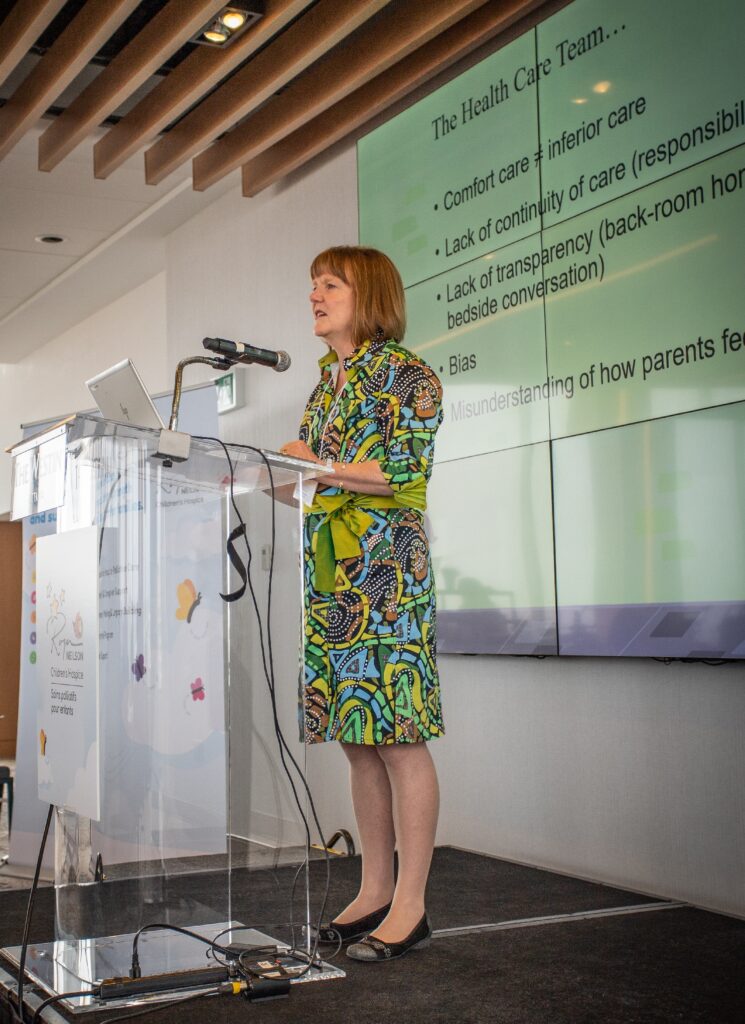
Interview with Dr. Davies: One of the first pediatric palliative care physicians in Canada
Dr. Dawn Davies has practiced pediatric palliative care medicine at Roger Neilson Children’s Hospice and CHEO since moving to Ottawa in 2018. A practicing pediatrician since 1997, Dr. Davies completed a fellowship in pediatric palliative medicine in 1999 becoming one of the first pediatric palliative care physicians in Canada.
Shaped by her experiences as a pediatric oncology nurse in the 1980s, Dr. Davies says that she started feeling, during those years, that there had to be a better way to improve end-of-life care for children. “We frequently had to bring kids into hospital, as there was no community palliative care, didn’t know how to manage their symptoms well, and often separated families in the process at this crucial time.”
Following graduation from medical school, and partway through her residency in pediatrics, Dr. Davies was inspired during grand rounds by a visiting physician from Texas. “She was the first physician I had ever known who specialized in palliative care for kids. Her presentation changed my life.”
Now one of six pediatric palliative care specialists working at CHEO and RNCH, Dr. Davies says that she and her colleagues usually meet families when a child is diagnosed with a life-threatening or life-limiting condition. “I explain that I am a pediatrician with extra training to ensure that their child will be as comfortable as possible during their illness. We want families to know that our team is there to provide support, continuity of care and a sounding board as they face some serious decisions. That they can rely on us to help package and decipher information and articulate what is important to them. Especially when time is short. Palliative care is also much broader than end-of-life care as our skill set is transferrable. So even in the cancer population we work alongside the oncology team to provide pain and symptom management while children and youth are receiving treatment.”
Once contact with palliative care has been initiated through a medical consult, other members of the palliative care team are brought in based on a family’s needs. Praising RNCH’s approach, Dr. Davies says that each member of the team contributes to taking care of patients and their families in a very holistic way. “This means supporting their spiritual and psychosocial needs, helping to build resilience in the child and family from the beginning, and being there during the bereavement process.”
Historically overlooked, Dr. Davies says that pediatric palliative care is a speciality that only continues to increase in importance. “I think that today’s children and their families are isolated in their tragic experiences. And because we live in a world with the technology, treatments, and specialities to keep almost anybody alive, palliative care brings to the conversation the subtle differences between doing something for someone and doing things to someone, at a point when treatment is failing.”
When describing what it takes to work in pediatric palliative care, Dr. Davies says that her speciality attracts all types of people who gravitate to the work for different reasons. “Core required elements would be having genuine empathy for others and interest in all people’s stories and experiences. Other musts include strong relational and communication skills. The need for traits like these make teams like ours so nice to belong to.”
Asked what she finds to be most rewarding about her work, Dr. Davies puts meaning at the top of her list. “There is great meaning in being present at someone’s birth but also in being there for the end of someone’s life. A child’s death will be a part of their legacy and the family will remember forever how it went.”
Sharing that people are often surprised to discover the upbeat atmosphere at RNCH she says there is also much lightness and laughter in the day-to-day work. “The focus of our work at RNCH is on the whole person and family, even in a medical role, and this makes for a very human and humbling experience. The goal is to assist children and youth with living well as long as one can, in the face of a lot of uncertainty and doubt. Families are often running a marathon, not a sprint, with their ill child, and they too need moments of fun and normal distraction.”
Adamant that every reasonably sized centre needs its own children’s hospice with a well-flushed out palliative care and bereavement team, Dr. Davies says that smaller centres can accomplish a lot with just a few staff members. “RNHC is a top-of-the-line leader in children’s palliative care, but hospitals can go far with a psychosocial expert, physician expert, and nursing expert.” Very optimistic about efforts to build and expand pediatric palliative care programs and facilities in other cities across Canada, Dr. Davies says that she is pleased with advancements in pediatric palliative care. “Most cities in Canada now offer pediatric palliative care. It has grown and blossomed immensely since 1999 which has been amazing to see.”
Our Stories
Discover the touching stories and journeys of children, families and caregivers.